Under Scrutiny | Investigation 001 | Part 05
There is a temptation, when investigating an organization like Second Sons Canada, to look immediately for what is hidden.
Private chats. Internal documents. Anonymous sources. Deleted posts. Information the organization never intended the public to see.
But sometimes the most revealing material is already sitting in plain sight.
Second Sons Canada has published a remarkable amount about itself on its own website. It explains who it believes belongs, why its members wear masks, what political activism means to the organization, what kind of men it wants to recruit, where it operates, how it screens applicants and how it understands Canadian identity.
The challenge is not finding the words.
It is reading them together.
A single sentence about ancestry may appear vague. A statement about immigration may sound like ordinary political criticism. A discussion about fitness may seem entirely separate from political organizing. A membership exception for certain foreign nationals might be dismissed as an administrative detail.
But when those things are placed beside one another — and then compared with the organization’s public actions — a clearer picture begins to emerge.
This article is based heavily on screenshots I preserved from the Second Sons Canada website on September 28, 2026. Rather than asking readers simply to accept my interpretation of what the organization says, I want to show the material itself and examine what it tells us.
The Homepage Sets the Tone
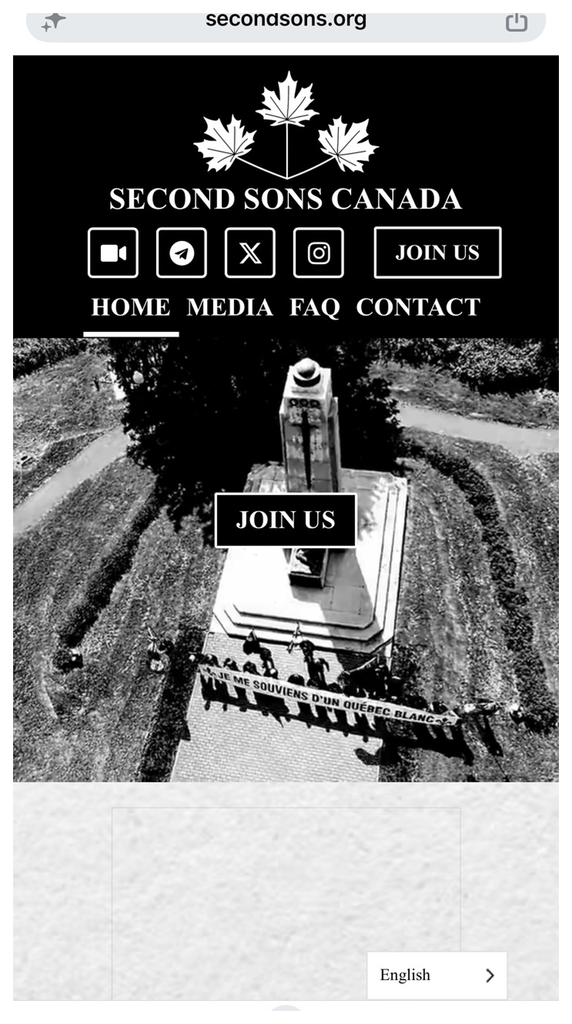
The Second Sons homepage does not begin like the website of an ordinary men’s fitness group.
Its language is historical, emotional and generational.
The site invokes forefathers, inherited legacy, national continuity and the idea that present-day Canadian men are links in a chain connecting the past to the future. It presents Canadian identity not simply as citizenship, but as something transmitted through generations.
That distinction becomes increasingly important as the page continues.
The homepage uses headings such as “The Torch; Be Yours to Hold It High!”, “Over the top!”, “All Thy Sons Command” and “Our People. Our Home. Our Future!”
On their own, those phrases might simply sound patriotic.
Placed beside the surrounding text, however, they carry a more specific meaning.
The organization speaks about the courage and camaraderie of “our forefathers,” descendants carrying the same DNA and spirit forward, and a national inheritance that must be preserved.
It is not merely saying that Canadians should care about history.
It is presenting national identity as an inheritance.
And inheritance, by definition, raises the question of who is considered an heir.
The Point Where Heritage Becomes Displacement
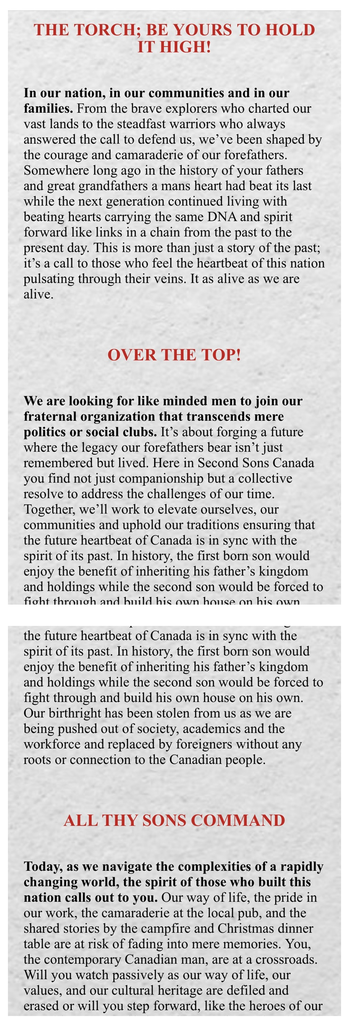
This is one of the most important screenshots in the entire investigation.
The site’s historical language eventually turns directly toward modern grievance.
Second Sons says contemporary Canadian men should be enjoying what earlier generations built, but instead claims their “birthright” has been stolen and that they are being pushed out of society, academics and the workforce and replaced by foreigners without roots or connection to the Canadian people.
This wording matters because it does more than criticize immigration policy.
It establishes a relationship between three ideas:
inheritance, displacement and foreignness.
The first part of the argument says something was built by previous generations.
The second says that something properly belongs to their descendants.
The third identifies foreigners as people receiving what those descendants should have inherited.
That is a much stronger claim than saying immigration levels are too high.
Canada can have perfectly legitimate arguments about population growth, housing, wages, infrastructure and immigration targets. Those debates concern public policy.
This language introduces something different: the idea that a particular group possesses an inherited claim to the country and that newcomers lack the necessary connection to belong in the same way.
That distinction is central to understanding much of what follows.
“Our People” Is a Simple Phrase With a Complicated Question Behind It
The homepage eventually arrives at the slogan:
Our People. Our Home. Our Future.
Again, the phrase itself is not proof of anything sinister.
Almost every political movement talks about “our people.”
The important question is how the organization defines the word our.
If membership in the national community simply means Canadian citizenship, then ancestry should be irrelevant.
If belonging is cultural, then culture can potentially be learned, shared and adopted.
If belonging is ancestral, however, the boundaries become very different.
Second Sons’ website repeatedly moves between these categories without clearly resolving them.
It speaks about Canadians.
It speaks about citizenship.
It speaks about ancestry.
It speaks about DNA.
It speaks about forefathers.
It speaks about outsiders having no roots or connection to the Canadian people.
The result is a definition of Canadian identity that appears broader than paperwork but narrower than simple citizenship.
That ambiguity deserves examination.
The Historical Quotations Are Part of the Presentation
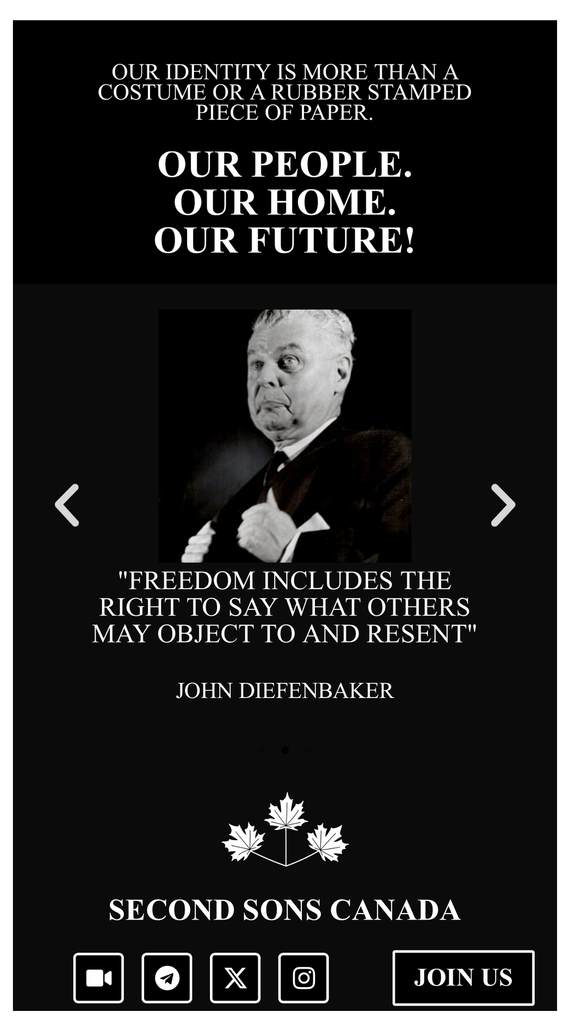
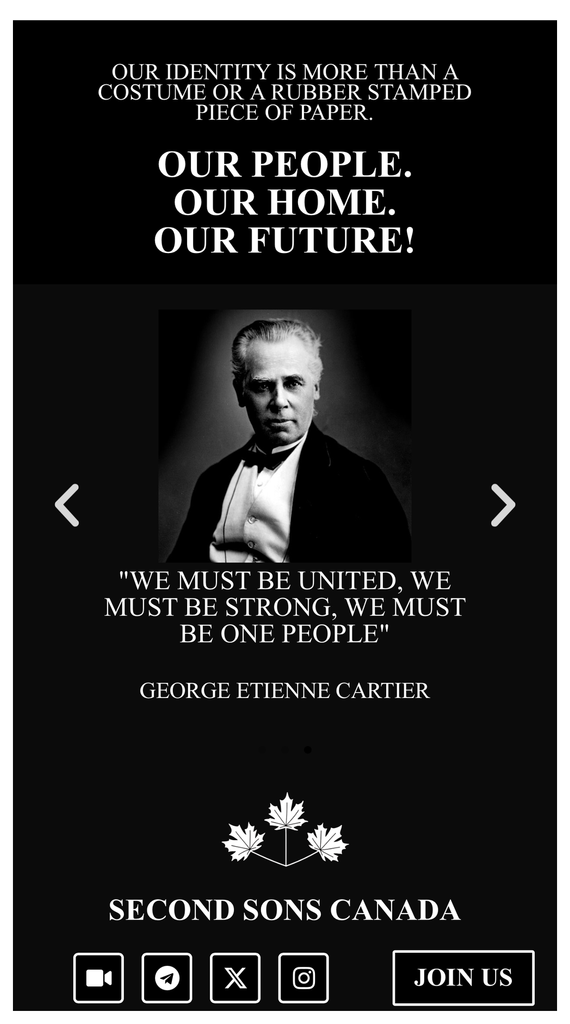
The homepage also features quotations from Canadian historical figures including John Diefenbaker, George-Étienne Cartier and Thomas D’Arcy McGee.
There is nothing unusual about quoting Canadian political figures.
But their inclusion contributes to the broader visual and rhetorical construction of the site.
The organization is not presenting itself merely as a modern protest group.
It is placing itself within a historical Canadian story.
That matters because the larger argument on the site depends heavily upon continuity: previous generations built something, the present generation inherited it, and the current generation now has a duty to protect it.
The quotations help surround that argument with recognizable Canadian history and legitimacy.
The more interesting question is not whether those historical figures would have agreed with Second Sons. There is no reason to assume they would.
The question is why the organization wants the visitor to associate its modern political project with Canada’s historical inheritance.
What the FAQ Says Second Sons Actually Is
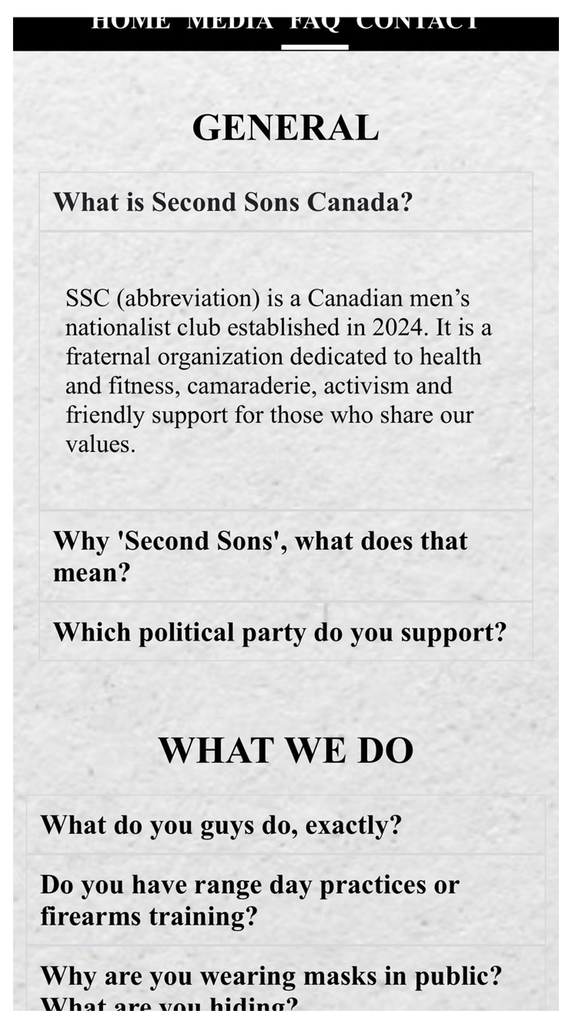
The FAQ provides the clearest formal description of the organization.
Second Sons calls itself a Canadian men’s nationalist club founded in 2024 and says it is dedicated to health and fitness, camaraderie, activism and support for people who share its values.
That description is worth taking seriously.
There is no need to pretend that the fitness component is fake.
Members clearly do train.
There is no need to assume that the friendships are fake.
Some men may genuinely join because they want companionship, structure, exercise and a sense of community.
Those things can all be real while the political ideology attached to them is also real.
In fact, the combination may be more important than either element separately.
Research into the wider Active Club movement has focused specifically on this mixture of male camaraderie, physical training and political organization. The Institute for Strategic Dialogue describes Second Sons as operating within that broader model and argues that fitness activities can function as tools for building political cohesion and organizational capacity. Institute for Strategic Dialogue
That makes the FAQ’s use of the word activism particularly significant.
It is not a side project.
It is part of the organization’s self-definition.
Why “Second Sons”?
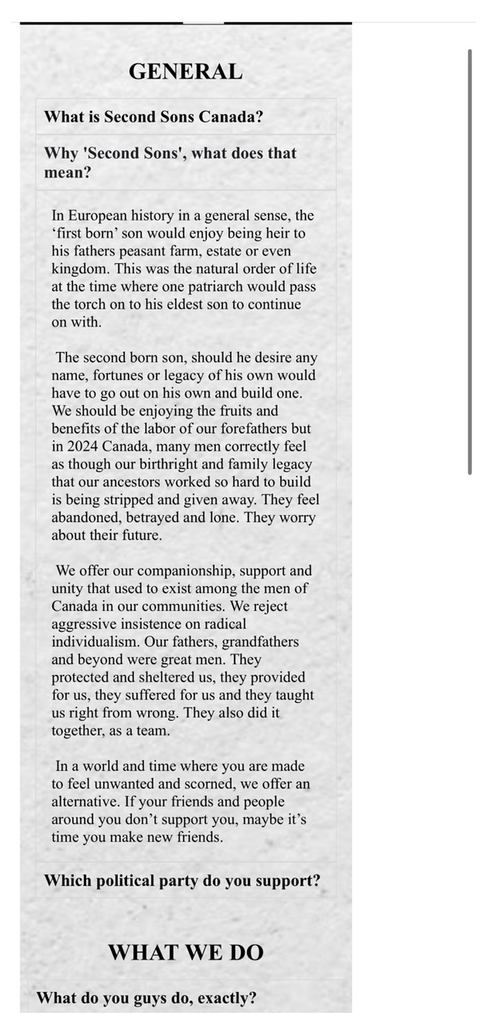
We examined the history behind the organization’s name in Part 03, but the website’s own explanation remains worth seeing.
Second Sons describes the historical first-born son as the heir to the farm, estate or kingdom, while the second-born son supposedly had to go out and build a name and fortune of his own.
The site then brings that historical metaphor directly into modern Canada.
It says contemporary men should be benefiting from what their ancestors built but instead feel that their birthright and family legacy are being stripped away.
This is where the branding stops being merely historical.
The second son becomes a political identity.
He is not simply the younger brother who does not inherit the farm.
He becomes the modern Canadian man who has supposedly been deprived of an inheritance.
And once again, that raises a fundamental question:
What exactly is the inheritance?
A house?
A job?
A culture?
Political power?
A racial majority?
The website does not define the boundary precisely.
That vagueness may be part of its usefulness.
Different readers can insert different grievances into the same story.
The Organization Says It Rejects the Political Establishment
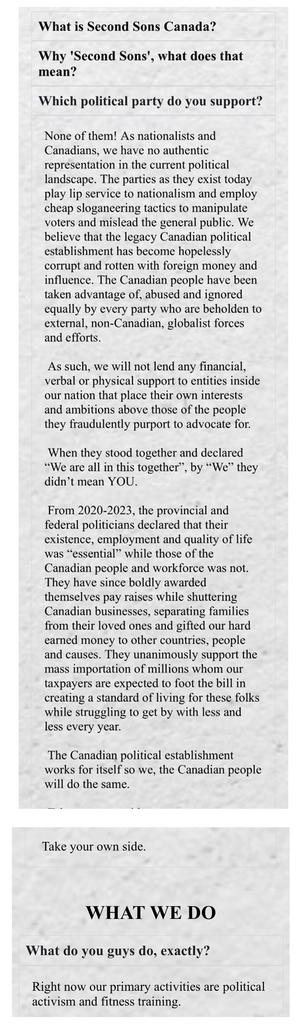
Second Sons says it supports no Canadian political party.
Its explanation is not simply that no party reflects its policy preferences.
The FAQ portrays Canada’s political establishment as corrupt, influenced by foreign interests and disconnected from ordinary Canadians.
It also complains about the “mass importation” of people whom taxpayers are expected to support.
Political frustration of this kind is hardly unique to Second Sons.
Distrust of government, frustration with pandemic-era policies, anger over immigration and resentment toward political elites exist across Canada.
What makes the Second Sons version important is how those grievances connect back to the site’s larger narrative.
Foreign influence.
Foreign people.
Lost inheritance.
Ancestral identity.
National betrayal.
When the same themes repeatedly reinforce one another, they become more than a collection of unrelated complaints.
They become a worldview.
What Do They Actually Do?
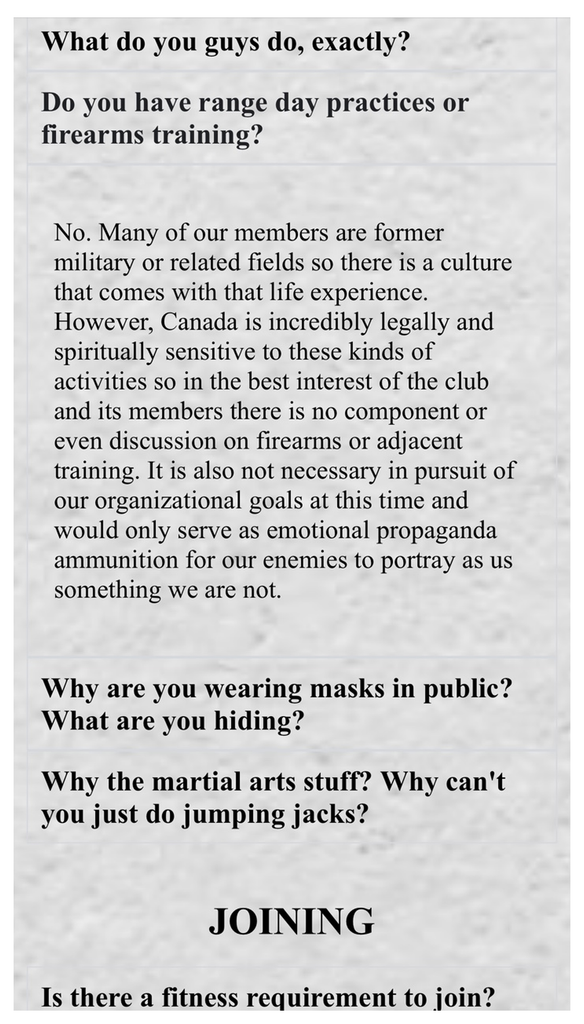
The FAQ answers this directly.
Second Sons says its primary activities are political activism and fitness training.
The organization lists social-media activity, flyers, stickers and public demonstrations among its forms of political activism.
It also describes physical fitness itself as an act of rebellion in a society it portrays as making people weak, exhausted and easily manipulated.
This is useful because it removes one possible misunderstanding.
The organization is not a fitness club that happens to have politics.
It explicitly combines the two.
That matters when we compare the website with the demonstrations examined in Part 04.
The CBC protests were political activism.
The remigration banner was political activism.
The Orillia highway demonstration was political activism.
The Shawinigan banner was political activism.
The Kamloops demonstration was political activism.
Those events are therefore not detached from the organization’s mission.
They are examples of the type of activity the organization tells prospective members it exists to conduct.
The Media Page May Be Even More Revealing Than the FAQ
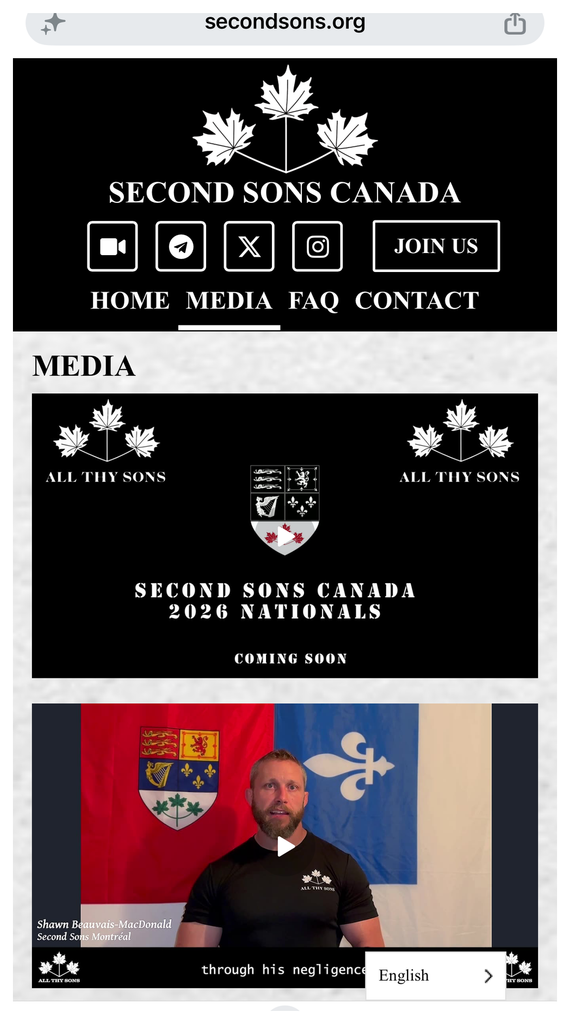
The media page provides a different kind of evidence because it shows what Second Sons chooses to showcase.
At the time the site was preserved, the page contained embedded material with titles including:
Je Me Souviens Un Québec Blanc
White Boy Winterlude
CBC HATES WHITE PEOPLE
Canada’s Destiny Will Be Decided by Canadians
Raise the Ensign
The significance here is not that an outside critic selected the most provocative moments from the organization’s history.
These were displayed on the organization’s own media page.
That matters.
A website’s media section is curated.
Someone decides what belongs there.
Someone decides which demonstrations, slogans and events represent the organization well enough to display to visitors.
When racial language appears not merely in a stray social-media comment but within the organization’s own presentation of its activities, it becomes harder to argue that such rhetoric exists entirely at the margins.
The Shawinigan demonstration is particularly important in that respect. In June 2026, Jeremy MacKenzie confirmed that Second Sons members were responsible for the demonstration featuring the “white Quebec” banner. TVA Nouvelles
The website then preserved media associated with that same message.
That is a meaningful connection between public action and organizational presentation.
The Masks: Protection, Strategy or Both?
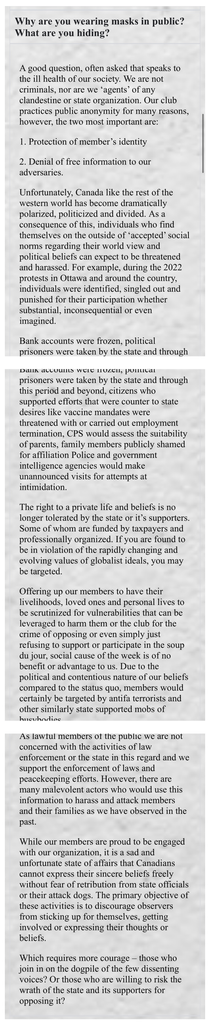
Second Sons devotes substantial space to explaining why members wear masks in public.
Its answer centres on anonymity.
The organization says members fear harassment, employment consequences and targeting by political opponents. It describes withholding members’ identities as both protection and a way of denying information to adversaries.
Some of those concerns are plausible.
People can lose jobs over controversial public conduct. Families can be harassed. Doxxing is real.
Masking therefore should not automatically be interpreted as evidence of criminal intent.
But the wording reveals something else about how Second Sons understands its environment.
The organization sees itself not simply as participating in political debate but as operating against adversaries.
That language appears repeatedly.
The state.
Political opponents.
Institutions.
Activists.
People attempting to identify members.
The effect is to reinforce an inside-versus-outside mentality: members belong to the protected group, while those outside the group may represent threats.
There is also a practical benefit to anonymity.
The organization can circulate provocative political imagery while many individual participants remain insulated from personal public scrutiny.
That does not prove anything about motive.
But it is part of how the organization has chosen to structure its activism.
Fitness Is Also a Test of Belonging
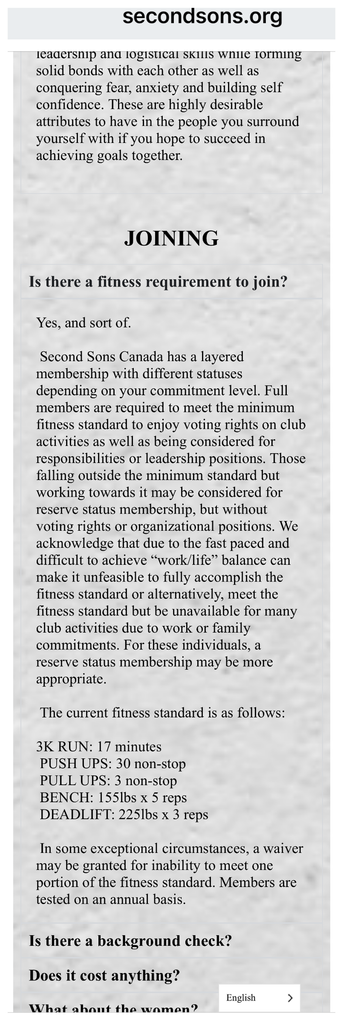
The fitness standards are unusually specific.
At the time of preservation, full members were expected to meet benchmarks including a three-kilometre run, push-ups, pull-ups, bench press and deadlift requirements.
Members who did not yet meet the standard could be considered for reserve status, while full members could receive voting rights and organizational responsibilities.
This tells us something important about the internal culture.
Fitness is not merely encouraged.
It helps determine status.
Physical performance therefore becomes part of membership identity and hierarchy.
The organization is quite explicit that physical development is connected to discipline, leadership and group effectiveness.
Viewed in isolation, that could describe any demanding athletic club.
Viewed alongside the organization’s political activism, however, the role of fitness becomes more consequential.
The organization is training men physically while also building political cohesion.
That connection is one reason researchers examining Active Clubs pay so much attention to the fitness component. ISD’s analysis argues that physical training in these networks can function as organizational practice rather than simply recreation. Institute for Strategic Dialogue
Membership: Canadian Citizenship — With Some Interesting Exceptions
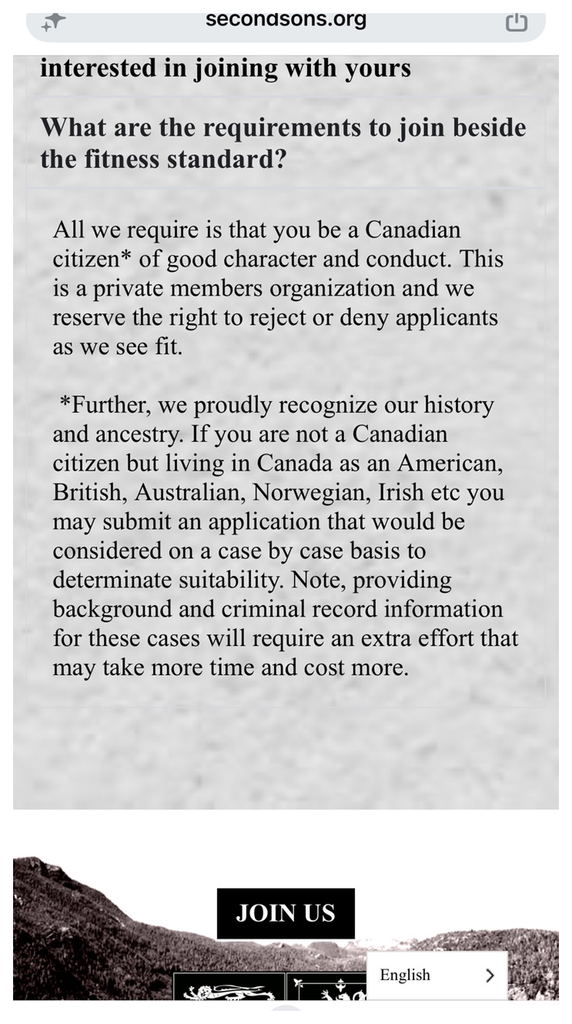
This remains one of the most revealing FAQ entries.
Second Sons says applicants generally must be Canadian citizens of good character.
Then comes an exception.
The organization says it proudly recognizes its “history and ancestry” and allows certain non-citizens living in Canada to apply on a case-by-case basis.
The examples it provides are Americans, British, Australians, Norwegians and Irish.
As I discussed in Part 02, that list should not be turned into proof of something it does not establish.
Nationality is not race.
Those countries contain people of many racial and ethnic backgrounds.
The site does not explicitly state that a white American would be accepted while an Indian or Nigerian citizen would be rejected.
We should not invent a policy that is not written there.
But the wording still deserves scrutiny.
Why is ancestry mentioned immediately before the exception?
Why are those particular nationalities given as examples?
What characteristics make them potentially suitable when citizenship is otherwise presented as the general requirement?
Would a non-citizen from India, Nigeria, Pakistan, China or the Philippines receive the same case-by-case consideration?
The website does not answer that.
That makes it an unresolved question rather than a proven conclusion.
But unanswered questions can still be important.
Geography Shows Ambition Beyond a Local Club
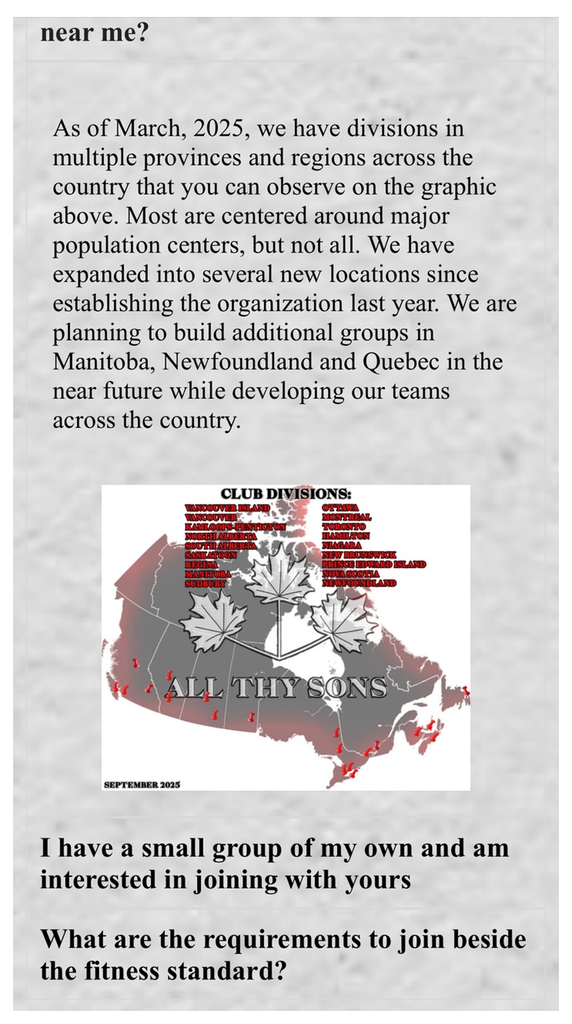
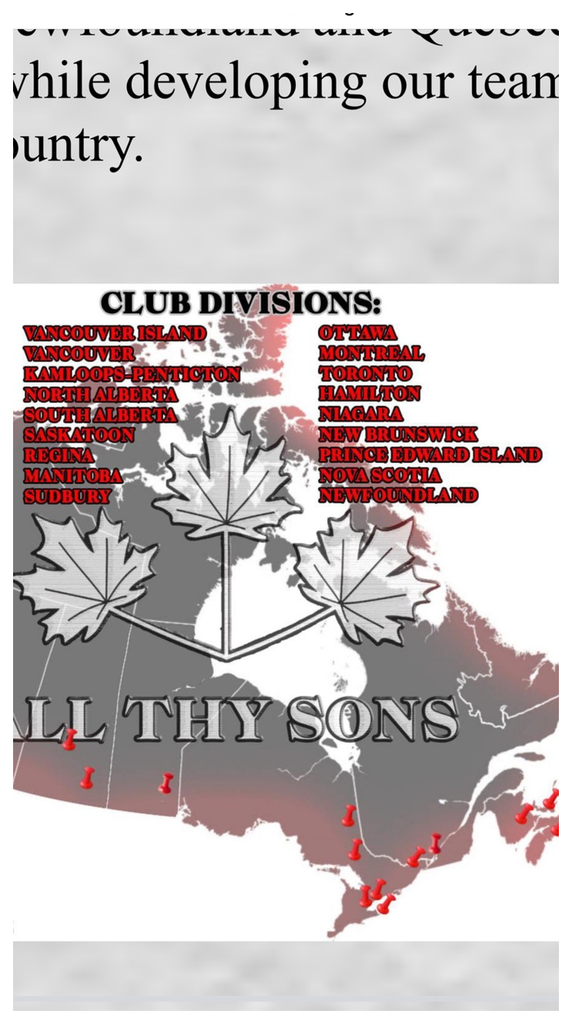
The website also presents Second Sons as a growing national organization.
Its FAQ says divisions had developed across multiple provinces and regions, while a separate map showed a wider network of named divisions.
The organization also invites smaller like-minded groups to contact it about cooperation and possible “patching over.”
That language suggests something more ambitious than a handful of friends meeting locally.
Second Sons is attempting to build infrastructure.
Local groups.
Shared identity.
Membership tiers.
Recruitment procedures.
Screening.
National branding.
Common political messaging.
That is worth distinguishing from simple online commentary.
The project is organizational.
The Application Form Shows What the Organization Wants to Know
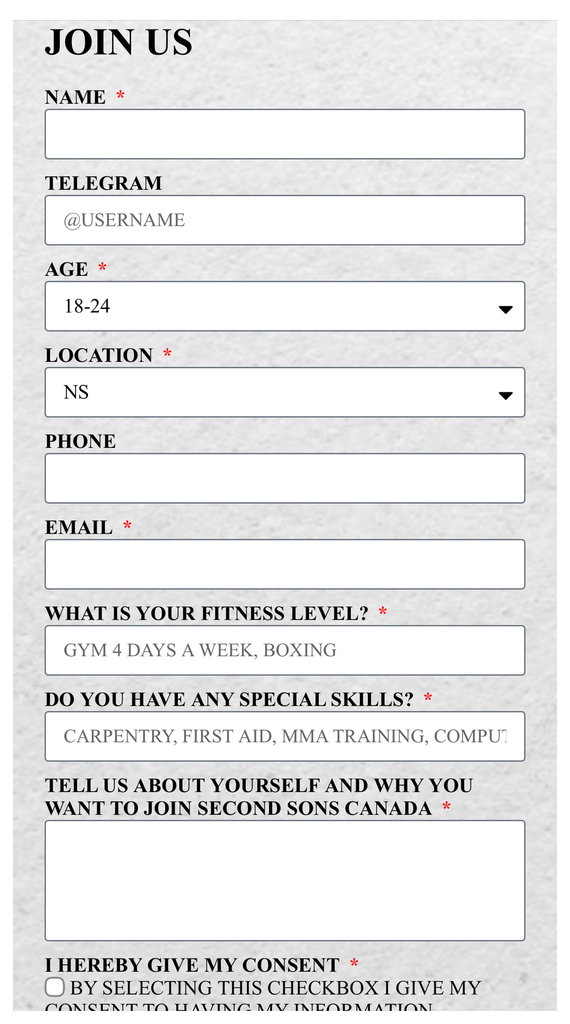
The Join Us page completes the picture.
Applicants are asked for identifying and contact information, their location, fitness level, special skills and why they want to join.
Examples of useful skills include areas such as carpentry, first aid, MMA training and computers.
That is a practical recruitment form.
It also shows that Second Sons is looking not merely for passive supporters but people who can contribute capabilities to the organization.
Again, none of those skills is inherently concerning.
Carpentry is not political.
First aid is not political.
Computers are not political.
Martial arts are not inherently political.
The relevance comes from what the larger organization intends to accomplish with the network it is building.
Skills do not define an ideology.
Purpose does.
The Website and the Actions Are Not Two Separate Stories
This is where the evidence from the last several parts of this investigation begins to converge.
If we looked only at the homepage, we might describe Second Sons as a nationalist men’s organization using emotionally charged language about heritage and immigration.
If we looked only at the fitness standards, we might see a demanding men’s club built around physical discipline.
If we looked only at the masks, we might see people attempting to protect their privacy.
If we looked only at a single demonstration, the organization could argue that one provocative banner was being overinterpreted.
But investigations become more meaningful when evidence is examined together.
The homepage speaks about forefathers, DNA and inherited national legacy. The FAQ says a birthright has been stripped away. The membership rules invoke ancestry. The organization promotes remigration. Its members have participated in demonstrations using explicitly racial language. Its own media page has showcased titles including “White Boy Winterlude,” “CBC HATES WHITE PEOPLE” and “Je Me Souviens Un Québec Blanc.”
And in September 2026, people associated with Second Sons appeared near the former Kamloops Indian Residential School before displaying a “Got Bones?” banner on a nearby overpass, an incident that prompted responses from Tk’emlúps leadership, local officials and police. Castanet Kamloops
Those facts do not require embellishment.
They are powerful precisely because they can be placed beside the organization’s own words.
Reading Between the Lines Does Not Mean Inventing What Is Not There
There is a danger in this kind of analysis. If you approach a website already convinced that every sentence contains hidden meaning, you can eventually make almost anything mean almost anything. That is not what this investigation is trying to do.
There are parts of the Second Sons website that are quite straightforward. The organization places a real emphasis on fitness, discipline, martial arts, background screening, membership structure and social cohesion. Those things should not be dismissed as meaningless simply because the organization is controversial.
But neither should they automatically be treated as separate from the organization’s political purpose.
Second Sons does not present fitness merely as recreation. Its own material links physical conditioning to discipline, leadership, confidence, bonding and organizational effectiveness. It screens prospective members, distinguishes between different membership statuses and emphasizes the development of capable, reliable men who share its values.
That does not prove that members are being trained for violence, revolution or tactical operations, and this investigation should not claim that without evidence.
What it does show is that the organization appears to value fitness, discipline and cohesion because those qualities make a political organization stronger and more effective.
That distinction matters.
A running standard is just a running standard when it belongs to a sports club. Martial arts are just martial arts when they belong to a martial-arts school. Background checks are simply screening when they belong to an ordinary association.
But Second Sons openly describes itself as a nationalist organization engaged in political activism. In that context, fitness, discipline, screening and group cohesion are not occurring in a political vacuum. They are part of the structure through which the organization builds and maintains its membership.
The purpose of close reading is not to manufacture sinister meaning where none exists. It is to notice when the same themes and organizational practices repeatedly reinforce one another.
Ancestry. Inheritance. Foreigners. Replacement. Remigration. Whiteness. National belonging. Political activism. Physical discipline. Group cohesion.
Once those ideas appear across the homepage, FAQ, membership rules, media page and public demonstrations, acknowledging the pattern is not speculation.
The important question is not whether Second Sons genuinely cares about fitness and discipline.
It is what those things are being built in service of.
What the Website Ultimately Reveals
The most interesting thing about the Second Sons website may be how much it tells us without appearing to tell us very much at all.
On one level, it is polished recruitment material built around familiar and potentially appealing ideas: get fit, make friends, become stronger, take responsibility, join a brotherhood and protect your community. Those ideas can be particularly attractive to men who feel isolated, politically alienated or uncertain about their future.
But woven through that message is another story — one in which something has been lost, something was inherited, and something that properly belonged to one group is now being received by someone else. The site repeatedly tells its audience that their ancestors built the country, that foreigners are replacing them, that identity is more than citizenship and that ancestry matters.
The organization does not have to write one neat paragraph explaining exactly where it draws the boundary around “our people.”
It has already given us the pieces.
The job of an investigation is to put those pieces together carefully, distinguish what is documented from what remains unanswered, and compare the organization’s words with what its members actually do.
In this case, we do not have to read minds.
We can read the website.
Stay curious. Look closer. Keep the conversation going.
— Laurie
Sources & References
-
Second Sons Canada — Official Website
Primary source for the organization’s homepage messaging concerning ancestry, forefathers, birthright, national identity and displacement. Website screenshots preserved September 28, 2026. -
Second Sons Canada — Official FAQ
Primary source for the organization’s self-description, political activism, fitness requirements, anonymity practices, membership structure, geography and citizenship requirements. -
Second Sons Canada — Media
Primary source for media selected and displayed by the organization, including material associated with its public demonstrations and messaging. -
Second Sons Canada — Join Us
Primary source for the organization’s application process, recruitment questions and requested applicant information. -
Institute for Strategic Dialogue — “Tribe and Train”: Examining Canada’s New Model of White Supremacist Mobilization
Steven Rai, March 17, 2026. Research examining Second Sons, Canadian Active Clubs, recruitment, fitness and political organizing. -
TVA Nouvelles — Second Sons Canada and the Shawinigan Demonstration
Reporting on the “Je me souviens d’un Québec blanc” demonstration and Jeremy MacKenzie’s confirmation that Second Sons members participated. -
CFJC Today — Tk’emlúps Leadership Responds to Second Sons Presence
September 2026 reporting on individuals associated with Second Sons gathering on Tk’emlúps te Secwépemc lands and the subsequent Kamloops overpass demonstration. -
Castanet Kamloops — RCMP Response to Second Sons Demonstration
Follow-up reporting documenting police contact with the group and the “Got Bones?” banner displayed in Kamloops.